For many transport companies in Vietnam, moving heavy machinery isn’t just about finding a trailer with enough capacity. The real challenge starts once you hit the road.
Construction sites, mining areas, rural routes, and mountain roads can be tough on equipment. Add humid weather, long rainy seasons, and heavy daily use, and a standard trailer may start showing problems faster than expected.
That’s why choosing the right Lowboy Trailer for Vietnam really matters. A well-built lowboy semi trailer helps reduce rust, protect the frame, improve cargo stability, and make heavy hauling safer under local working conditions.
This guide looks at the common problems operators face in Vietnam — and how the right trailer design can help solve them.
Table of Contents
Common Lowboy Trailer Problems in Vietnam
Lowboy trailers spend a lot of time on roads that are far from perfect. And in Vietnam, operators keep running into the same old problems, time after time.
- Rust and Corrosion on Lowboy Semi Trailers
Vietnam’s humid climate is tough on steel parts. And if you’re near the coast, salt in the air makes things worse.
If a lowboy semi trailer doesn’t come with proper anti-rust treatment, you’ll start seeing corrosion on the chassis, ramps, joints, and any exposed metal. Over time, rust eats into the trailer — shorter life, more repairs, more cost.
- Frame Stress on Rough Roads
Heavy equipment puts significant stress on the trailer frame.
On construction roads, mountain routes, or uneven rural roads, weak steel and poor welding turn into real hazards. A frame that’s too thin can bend, crack, or lose its stability after carrying heavy loads repeatedly.
For operators who move machinery every day, the frame is not just a structural part—it’s the key factor in whether the trailer can continue working safely.
- Cargo Shifting During Transport
Excavators, rollers, loaders, and bulldozers do not always have even weight distribution.
If the trailer does not have strong lashing points, cargo may move during transport. This is especially dangerous on slopes, sharp turns, or bumpy roads.
Even a short movement on the deck can damage equipment or create safety risks for the driver.
- Local Compliance and Road Safety Issues
A lowboy trailer truck also needs to match local transport requirements. In Vietnam, all lowboy trailers must comply with the National Technical Regulation on Safety and Environmental Protection (QCVN 11:2024/BGTVT) issued by the Ministry of Transport.
Operators should check axle load, overall dimensions, lighting, reflective tape, warning signs, and permit needs for oversized cargo. These details may look small, but they can affect daily operation, especially on long-distance routes.
How to Choose the Right Lowboy Trailer for Vietnam?
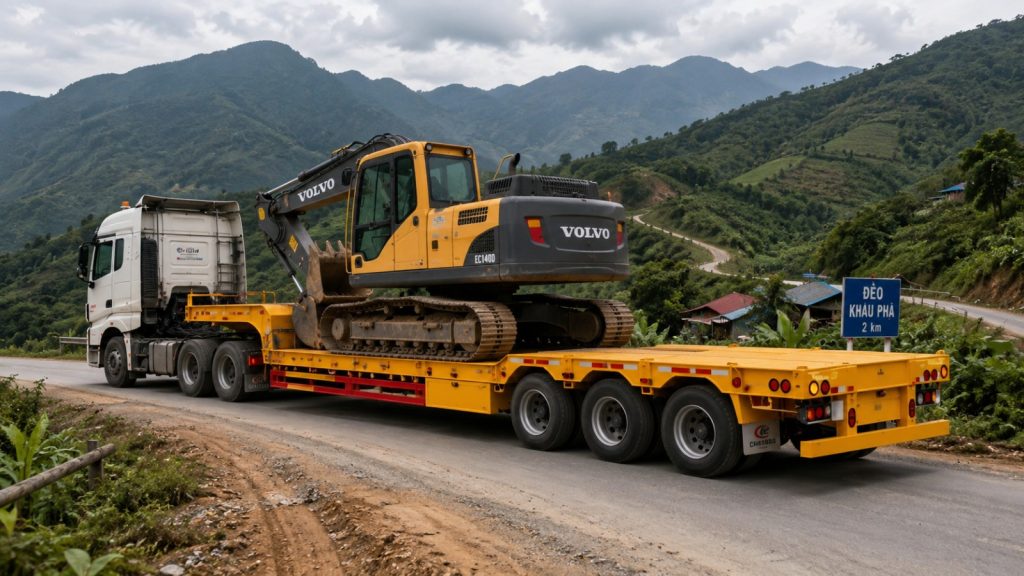
There is no single trailer that fits every project. The right choice depends on cargo weight, road condition, working route, and loading frequency.
1. Heavy Duty Lowboy Trailer for Large Equipment
For excavators, bulldozers, drilling machines, and other heavy construction equipment, a heavy duty lowboy trailer is usually the safer choice.
A stronger main beam, reinforced deck, durable ramps, and reliable suspension can help the trailer handle rough roads and repeated loading.
This type of trailer is better for operators who transport heavy machinery often, not just once in a while.
2. 4 Axle Lowboy Trailer for Better Load Distribution
A 4 axle lowboy trailer can be useful when the cargo is heavy and weight distribution matters.
More axles can help spread the load more evenly. This is helpful for long-distance transport, road projects, and heavy hauling jobs where stability is important.
For Vietnam’s mixed road conditions, this setup can offer a better balance between capacity and road performance.
3. Small Lowboy Trailer for Narrow Rural Roads
Not every job needs the largest trailer.
A small lowboy trailer can be more practical for compact machines, rural roads, or job sites with limited turning space. It may be easier to operate in narrow villages, smaller construction areas, or short-distance equipment transfer.
The key is to match the trailer size with the machine, route, and loading environment.
4. Lowboy Gooseneck Trailer for Long Hauls
A lowboy gooseneck trailer, also called a gooseneck lowboy trailer, can offer better connection stability between the tractor and trailer.
This design is useful for highway transport, mountain routes, or long working hours. It can also help reduce sway when the trailer carries tall or heavy equipment.
| Trailer Type | Suitable Scenarios | Unsuitable Scenarios |
| Heavy Duty Lowboy | Excavators, bulldozers & regular haulage | Occasional small equipment delivery |
| 4 Axle Lowboy | Long haul, heavy load, even weight distribution | Narrow country roads |
| Small Lowboy | Narrow roads, small machinery | Large equipment |
| Gooseneck Lowboy | Highways, mountain roads, long runs | Short-distance transit |
Lowboy Trailer Truck Checks Before Operation
Before putting a trailer into daily service, operators should look beyond just payload capacity. A safe lowboy trailer truck setup depends on many details.
Before each transport job, verify the following:
- Trailer length, width, and loading height
- Axle capacity and suspension condition
- Brake system and air lines
- Tires and tire pressure
- Ramp strength and loading angle
- Lashing points and chains
- Reflective tape and lighting system
- Warning signs for oversized cargo
- Local permit requirements
A good setup always matches both the machine being transported and the road it will travel on.
Safe Loading Tips for Lowboy Tractor Trailer Use
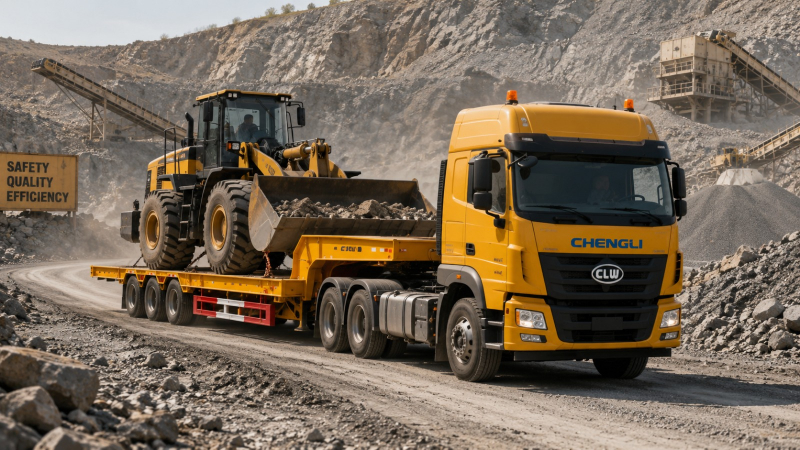
Safe loading is one of the most important parts of heavy equipment transport. Even a strong lowboy tractor trailer can become unsafe if the machine is placed poorly or tied down incorrectly.
1. Keep the Load Balanced
Place the machine near the center of the trailer deck. Avoid putting too much weight on one side or one axle group.
For excavators, pay special attention to the boom, bucket, and counterweight position — these parts can shift the balance during transport.
2. Use Strong Lashing Points
Secure cargo with proper chains, binders, or heavy-duty straps. Never rely on a single fixing point.
For long trips, drivers should stop and re-check the tension after driving through rough roads or mountain sections.
3. Control Speed on Rough Roads
A lowboy tractor trailer carrying heavy machinery needs more distance to slow down and turn.
On gravel roads, wet roads, or downhill sections, a lower speed reduces cargo movement, tire stress, and frame impact.
Maintenance Tips for Vietnam’s Climate
A lowboy trailer in Vietnam needs regular maintenance — the climate and roads are hard on the trailer body. Simple habits can significantly extend service life.
Recommended maintenance routine:
- Check the frame, welds, ramps, and suspension regularly
- Wash mud and dirt from the chassis after heavy use
- Inspect tires before long-distance transport
- Keep the brake system clean and responsive
- Apply anti-rust treatment to exposed metal parts
- Repair paint damage before rust spreads
- Pay extra attention during the rainy season
Small maintenance work is much cheaper than major frame repair or unexpected downtime.
Conclusion
A good lowboy trailer isn’t just a machine-moving tool. For construction, mining, and logistics work in Vietnam, it has to handle rough roads, humid weather, heavy loads, and the strain of daily operation.
The right Lowboy Trailer for Vietnam needs to match your cargo weight, road conditions, loading method, and local operating demands. For some buyers, that means a 4-axle lowboy trailer for extra capacity. For others, a small lowboy trailer or a lowboy gooseneck trailer is the more practical choice.
Ready to improve your heavy equipment transport in Vietnam? Contact our team to discuss your cargo type, road conditions, and required trailer configuration. We can help you choose a reliable lowboy semi trailer solution for construction machinery, mining equipment, and long-distance heavy hauling projects.