If you have searched Google for “garbage truck compactor” or “how much does a garbage truck cost”, you already know something is wrong. Your current trucks cost too much, work too slowly, and waste fuel, wages, and time on every single trip.
Indian cities generate over 150,000 tons of municipal waste daily, yet most still rely on open trucks or simple dumpers. These trucks carry mostly air – because the garbage is loose, not compacted. The result: drivers make 3–4 trips to the landfill every day, fuel and wages are wasted, and loose waste falls onto roads, attracting dogs, rats, and insects. Citizens complain. The city looks dirty.
You may have bought a “garbage truck” before that did not compact well, or was too big for narrow streets. If this sounds like you, keep reading. You are not alone.
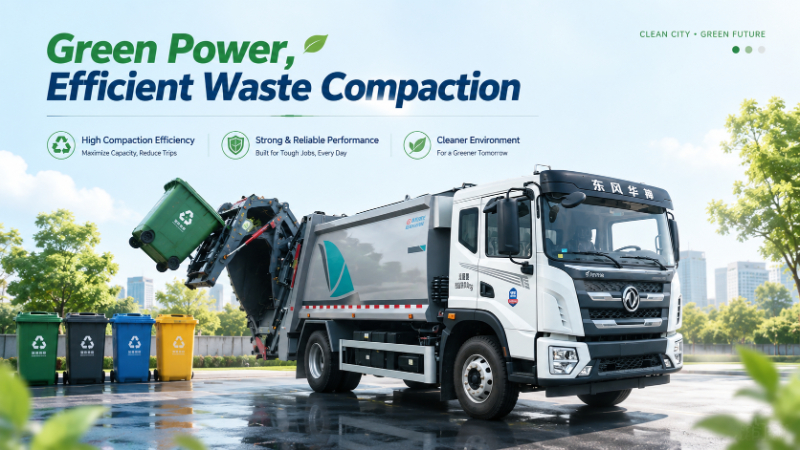
Table of Contents
Normal Trucks Waste Your Money – A Garbage Truck Compactor Solves That
Many Indian cities use simple dump trucks for garbage. These trucks have a big box, but the garbage is loose. Loose garbage takes up space but does not weigh much. So the truck never carries its full weight. Drivers must go to the landfill 3 or 4 times a day.
Let’s take one area in Bengaluru. Ten normal trucks make 4 trips each day. That is 800 kilometers driven, 160 liters of diesel, and 16 hours of driver time. Garbage leaks from the trucks. Residents complain 3 times a week. At the landfill, trucks wait in line for 2 hours. The cost of fuel and labor is over $60,000 per year. That is enough money to buy a new small garbage truck with compaction.
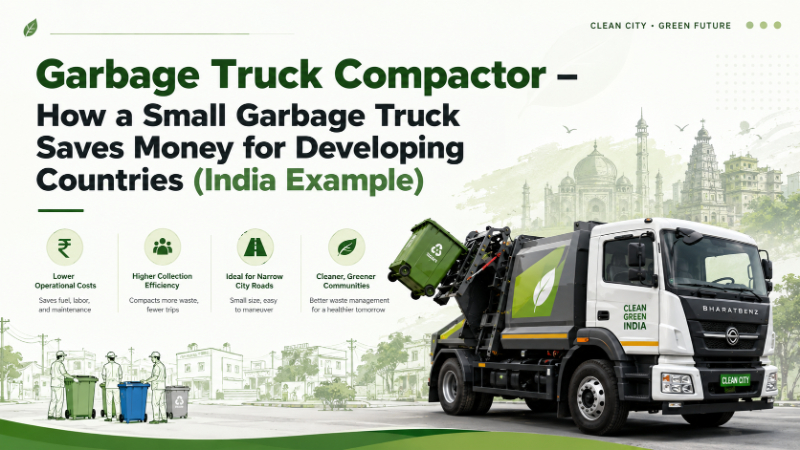
A garbage truck compactor uses a hydraulic plate or a screw. It pushes the garbage together. Normal density is 0.2 tons per cubic meter. Compacted density is 0.6 to 0.8 tons per cubic meter. So the same box can hold 3 to 4 times more waste. What took 4 trips now takes only 1 trip.
In India, the best choice is a rear loader garbage truck. Why? It is simple. Spare parts are easy to find (Tata, Ashok Leyland). It compacts at a 4:1 ratio. An automated side loader is faster, but it needs special bins and costs more. That model is only good for pilot projects.
A Garbage Truck Compactor Solves Your Three Biggest Problems
- Problem 1 – High operating costs. Many buyers look only at the truck price. But operating costs often become larger than the purchase price within two years. A garbage truck compactor makes fewer trips. So you use less fuel, fewer tires, less driver time, and less maintenance. Example from Ahmedabad: A private waste company bought an 8m³ rear loader compactor.
- Before: monthly diesel cost $2,800. (
₹266,980) - After: $1,100. Drivers went from 3 shifts to 2 shifts. Total saving per year: $42,000 (
₹3,994,700) . The truck cost $75,000(₹7,151,250). They got their money back in 21 months.
- Before: monthly diesel cost $2,800. (
- Problem 2 – Narrow streets. Old city lanes in India are only 2.5 to 3 meters wide. A normal 6‑ton truck cannot turn. That is why many people search for “small garbage truck” (390 searches per month) and “compact garbage truck” (competition is zero). A 4‑ton compact compactor is less than 2 meters wide. It can reverse into narrow lanes and collect garbage easily.
- Problem 3 – Hard-to-repair and expensive parts. We recommend compactors with simple mechanics. Avoid complex hydraulics or special electronics. The best garbage truck compactor for developing countries uses a common chassis like Tata, Ashok Leyland, or Isuzu. Local workshops can make or repair packer blades and rams. In contrast, an expensive European side loader may stop working for months, just because a small circuit board breaks.
5 Things You Must Check Before Buying a Garbage Truck Compactor for India
- Compaction force. Do not trust ads that say “high compaction ratio”. Ask the seller: What final density (kg per cubic meter) does the garbage truck compactor reach? Indian garbage contains food, plastic, and soil. The compactor needs at least 25 tons of force. When you search for “garbage truck compactor”, look for sellers who give real test data.
- Turning radius. The difference between “works” and “stuck” in Gurgaon’s new sectors? An 8‑meter radius is fine. In Old Delhi, Varanasi, or Jaipur’s walled city? You need under 6 meters. Why it matters: A truck that cannot turn around will block traffic, damage walls, and waste 30+ minutes reversing out. What to choose: A small garbage truck of 6m³ or less, with a short wheelbase. Ask the seller for the exact turning radius in writing.
- Leachate collection (dirty water). India is hot. Food waste rots fast and makes dirty water (leachate). Normal trucks leak this water on the road. It smells terrible. A proper garbage truck compactor must have a sealed tank with a drain valve. Cheap trucks do not have this. Later, you have to add it – and it costs extra.
- Chassis brand and spare parts. In India, Tata and Ashok Leyland have the most service centers. Buy a compactor body built on these chassis. The keyword “Isuzu garbage truck” also has some searches, but Isuzu parts are more expensive and slower to get unless you live near a port city.
- Training for drivers. The compactor can crush hands or feet. Ask the seller to give simple picture manuals in English and Hindi (or your local language). Ask for remote or on‑site training. Never buy a garbage truck compactor that needs special computer tools for basic adjustments.
Real Numbers – How a Garbage Truck Compactor Saves You Money
Let’s compare a normal 10‑ton dumper vs. an 8m³ rear loader garbage truck compactor. These are real 2025 costs in India (US dollars).
| Item | Normal Dumper (10t) | Rear Loader Compactor (8m³) |
| Purchase price | ₹3,337,250 | ₹6,674,500 |
| Net waste per trip | 3 tons (loose) | 6.5 tons (compacted) |
| Trips per day (10‑hour shift) | 3 | 1.5 |
| Diesel per day (liters) | 45 | 30 |
| Driver cost per day | ₹2,288.40 (2 drivers) | ₹1,525.60 (1.5 drivers) |
| Total operating cost per year | ₹2,078,630 | ₹1,287,225 |
| Money saved per year | / | ₹791,405 |
The compactor costs $35,000 more at the start. But it saves $8,300 every year. You get your extra money back in 4.2 years. After that, you save money every year. Also, a compactor lasts 3–5 years longer than a normal dumper. If you buy a used (reconditioned) garbage truck compactor from Singapore or the Middle East, you can get your money back in less than 2 years. Fewer trips also mean less traffic at the landfill and less air pollution. You may also get cheap loans from green financing programs. For example, India’s Swachh Bharat Mission (Clean India Mission) gives subsidized loans for efficient compactors.
The World Bank is a trusted source for waste data. Their report “What a Waste 2.0” shows that global garbage will grow by 70% by 2050. You can read it here: World Bank – What a Waste 2.0
The United Nations Environment Programme (UNEP) also published a report in 2024. It says we must move from “waste” to “resources”. Using a garbage truck compactor matches this idea. See the UNEP report here: UNEP – Global Waste Management Outlook 2024
Summary
A garbage truck compactor is not a luxury. It is a tool that saves money and keeps cities clean. Now you understand: Without compaction, you waste 60% of each truck’s space. That is a high hidden cost. The rear loader garbage truck and small garbage truck (or compact garbage truck) are best for Indian roads and local repairs. An 8m³ compactor pays for itself in about 4 years. After that, it saves you more than $8,000 per year. When you buy, check the compaction force, turning radius, leachate tank, chassis brand, and driver training.
Are you planning waste collection for a city, factory, or housing society in India? Stop wasting money on loose garbage. Contact us today for three free things: A custom recommendation – which garbage truck compactor fits your daily garbage amount and street width. Real operating data from cities like Mumbai, Delhi, Bengaluru, and Chennai. A 2026 price list for Tata‑chassis rear loader compactors.