You’ve got the concrete mixer on site. Great. But how do you get that concrete up to the 15th floor, across a bridge deck, or down into a narrow foundation trench? That’s the real headache.
If you rely on wheelbarrows, buckets, or cranes, you’ll need extra workers and a lot of patience. The whole project slows down. High places, long distances, and tight job sites make it even worse.
A concrete pump truck changes that. It pumps concrete exactly where you need it—higher, farther, or into tricky corners. In this article, I’ll show you how it solves common placement problems, what types are available, and what to check before you buy.
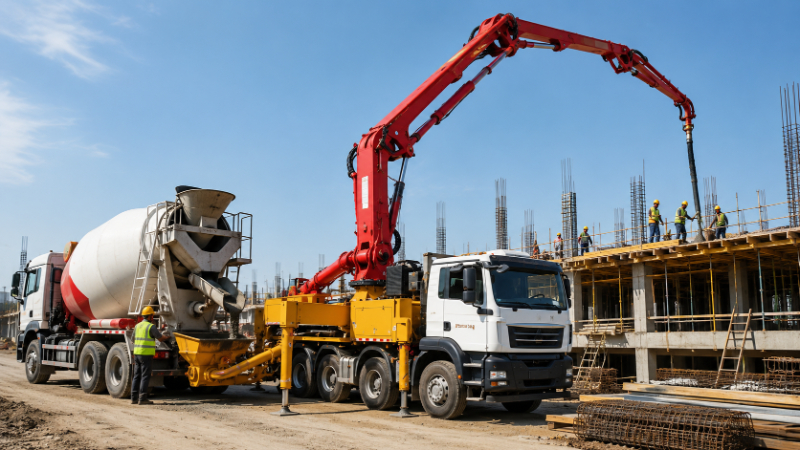
Table of Contents
Why Concrete Placement Is Difficult on Job Sites?
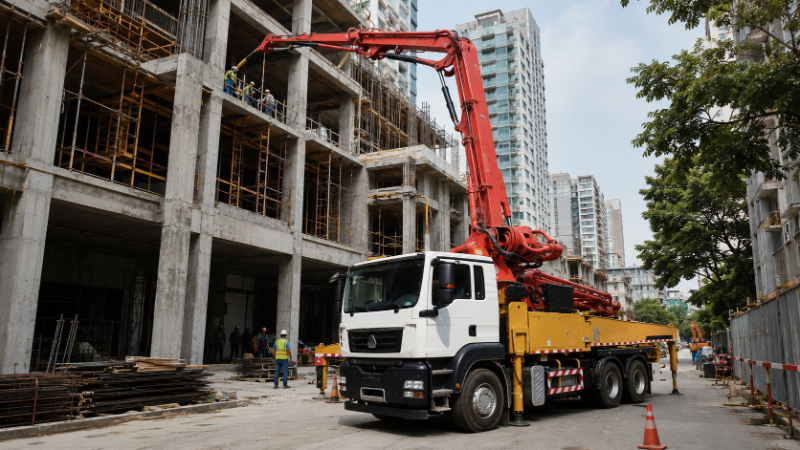
Concrete placement isn’t just about getting the material to the site. It’s about getting it to the right spot without wasting time or labor. Here’s why that’s harder than it sounds.
Manual Pouring Takes More Time
For a small sidewalk or a tiny shed, manual pouring works fine. A few workers with carts or buckets can handle it.
But for a building, bridge, or road project? Manual methods are painfully slow. The farther you need to move the concrete, the longer each trip takes. The pour stops and starts. Workers get tired. And the schedule starts slipping.
Concrete May Need to Reach Higher or Farther Areas
A mixer truck can only back up so close to the pour point. The actual spot might be:
- On an upper floor
- In the middle of a bridge deck
- Inside a building frame
- Down in a basement or foundation pit
If you can’t get the concrete up there steadily, your crew ends up waiting around. That kills efficiency.
Busy or Narrow Sites Make Work Harder
Urban job sites are crowded. Mixers, cranes, rebar, formwork, and workers all fight for space. When the site is narrow, a mixer truck might not even reach the right position.
You need a way to move concrete without adding more ground traffic. That’s where a concrete pump truck becomes a game-changer.
For more information about concrete work hazards, buyers can also review OSHA’s concrete and concrete products safety resources before planning job site operations.
How does a Concrete Pump Truck Solves These Problems?
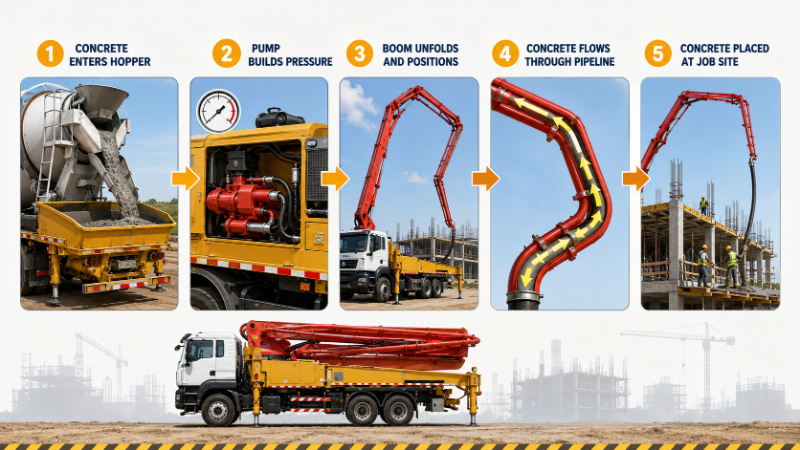
A concrete pump truck takes concrete from the mixer and sends it through a pipe or boom directly to the pour point. No wheelbarrows. No lifting. No long walks.
Direct Pumping to the Pouring Point
The process is simple: the mixer unloads into the pump’s hopper. The pump pushes the concrete through a pipeline. A hose or boom guides it exactly where you need it.
This means workers can focus on placing and finishing—not hauling. It works great for buildings, bridges, roads, tunnels, and other infrastructure jobs.
Better Efficiency on Job Sites
Once the pump truck is set up, you get a steady rhythm. The mixer keeps feeding the hopper. The pump keeps delivering to the pour point. No stops, no waiting.
Your crew works faster. You need fewer people moving concrete. And the whole project flows more smoothly.
Longer Reach for High or Difficult Areas
For high-rise buildings or large bridge decks, a concrete boom pump truck is the answer. It has a folding boom that unfolds like a crane. That boom can reach up dozens of meters or stretch far out horizontally.
Before you rent or buy one, check:
- Boom length
- Vertical reach
- Horizontal reach
- How much space do you need for outriggers
- Ground stability
A longer boom gives you more options—but you need room to set it up safely.
Main Types of Concrete Pump Trucks
Not every job needs the same machine. Here are the most common types you’ll come across.
Concrete Boom Pump Truck
This is the one you see on most big construction sites. The concrete boom pump truck has a long, folding boom mounted on the truck. It can pour concrete on high floors, across large slabs, or onto bridge decks.
It’s powerful and fast. But it also costs more and needs a skilled operator.
For operator training and safe pumping practices, buyers can also review the ACPA concrete pump operator certification program.
Small Concrete Pump Truck
If your job is smaller—like a low-rise building, a rural road, or a repair project—a small concrete pump truck might be a better fit.
It’s easier to move around tight spaces. It costs less. And it’s simpler to operate. Many contractors in Africa, Latin America, and Southeast Asia prefer this type because it works well on narrow roads and smaller budgets.
Concrete Mixer and Pump Truck
This one does two jobs: it mixes the concrete and pumps it. A concrete mixer and pump truck is useful when you don’t have a ready-mix plant nearby or when your project is small and scattered.
But keep in mind: it can’t match the reach or speed of a full-size boom pump. It’s best for light, low-volume work.
Concrete Pumping Truck
You’ll sometimes hear buyers say concrete pumping truck as a general term. That can mean a boom pump, a small pump, or even a trailer pump.
So when you ask for a quote, be specific. Tell the supplier the type, boom length, and pumping capacity you actually need. That saves everyone time.
Key Points to Check Before Buying a Concrete Pump Truck
Buying a pump truck is a big decision. The right one keeps your project moving. The wrong one becomes an expensive headache. Here’s what to look at first.
Working Height and Pumping Distance
How high up do you need to pour? How far away from the truck?
These two numbers decide the boom length and pump size you need. Don’t just buy the biggest one—buy the one that fits your actual site.
Pumping Capacity and Project Size
Think about your daily concrete volume. A large high-rise needs high capacity. A small house or a road repair doesn’t.
Match the pump’s output to your mixer supply. If the mixers can’t keep up, a bigger pump won’t help.
Chassis, Road Conditions, and Emission Standard
The chassis matters more than you think. It affects how the truck handles rough roads, mud, or steep hills.
Also check:
- Left-hand or right-hand drive?
- Local emission rules
- How easy it is to get spare parts
For markets like Africa, Latin America, and Southeast Asia, pick a durable chassis with good local support.
Maintenance and Spare Parts
A pump truck has several systems: hydraulics, boom, pipes, hopper, and outriggers. All of them need regular checks.
Ask the supplier:
- Are common wear parts easy to find?
- Can you get delivery pipes quickly?
- Do they provide maintenance guides?
For long-term projects, easy maintenance is more valuable than a fancy feature you’ll never use.
Conclusion
Concrete placement is never just about getting the material on site. The real challenge is moving it to the right spot—high up, far away, or into a tight space.
A concrete pump truck solves that. It cuts down on manual labor, keeps the pour moving, and reaches places a mixer truck can’t.
Depending on your job, you might need a concrete boom pump truck for high-rise buildings, a small concrete pump truck for narrow or rural sites, or a concrete mixer and pump truck for small, scattered pours.
Before you buy, check your working height, pumping distance, project size, road conditions, and budget. Then talk to a supplier who listens.
Ready to improve your concrete placement? Contact CLW today. Tell us your project type, working height, pumping distance, local road conditions, and budget. We’ll help you find the right concrete pump truck for your job site.